Product discovery services that de-risk what you build next.
Before you commit a budget or a development team, digital product discovery tells you whether the idea is worth building. In 2–4 weeks we prototype and pressure-test the concept with your team and stakeholders, check it against your data and technical constraints, and leave you with a clear, costed plan for what happens next.


















The problems that bring
teams to discovery.
If any of these sound familiar, discovery is usually the right place to start — the section below is how we approach them.
Ideas nobody’s tested
You've got a strong hunch, but no evidence yet that it's what users actually want, need or will pay for.
Stakeholders who don’t agree
Everyone has a different idea of what “it” is. Without a shared, tested concept, decisions stall or go in circles.
Budget at risk before proof
Committing a full development budget to an unproven idea is how projects quietly become the most expensive mistake of the year.
No cheap way to test it
Without a prototype, the only way to learn if something works is to build it for real — the most expensive way to find out.
Test it before
you build it.
Most product failures aren't technical — they're the result of building something nobody validated first. Our software product discovery services turn a raw idea into a de-risked, fundable plan: tested with your team and stakeholders, checked against your data and technical constraints, and costed before a single line of code is written.
Discovery de-risks everything that comes after it.
Skipping discovery is the single most expensive shortcut in software — teams spend months building the wrong thing because nobody tested the idea first. We combine rapid AI-assisted prototyping, stakeholder input and technical feasibility review so you commit real budget only once you know it's worth it.
Evidence before investment
We test the idea with your team and against real constraints before you commit a development budget — so the decision to build is backed by evidence, not guesswork.
One team, start to scale
The same senior team that runs your discovery designs and builds what comes next, so nothing gets lost in translation between what we found and what we ship.
A fixed-scope roadmap
You leave with more than a slide deck: a validated concept, a testable prototype, and a fixed-scope plan and price for the build phase.
Weeks, not months
Most discovery engagements run 2–4 weeks — fast enough to keep momentum, thorough enough to actually change your decision.
A working method, not a deck of phases.
Discover
We get into the detail. Stakeholders, constraints, data, and the real problem you're trying to solve.
Strategise
We sketch the smallest version that proves the outcome. A clear plan, a tight scope, no fluff.
Build
Cross-functional pods of engineers, designers, and data folk. Working software every week.
Scale
We harden it, instrument it, and stick around. Roadmaps, reviews, and a team that knows your stack.
Not sure if the idea is ready? Ask the engineer who’d test it.
Book a 30-minute working session with a senior engineer — a real conversation about your problem, not a sales call.
Built with clients
who measure outcomes.
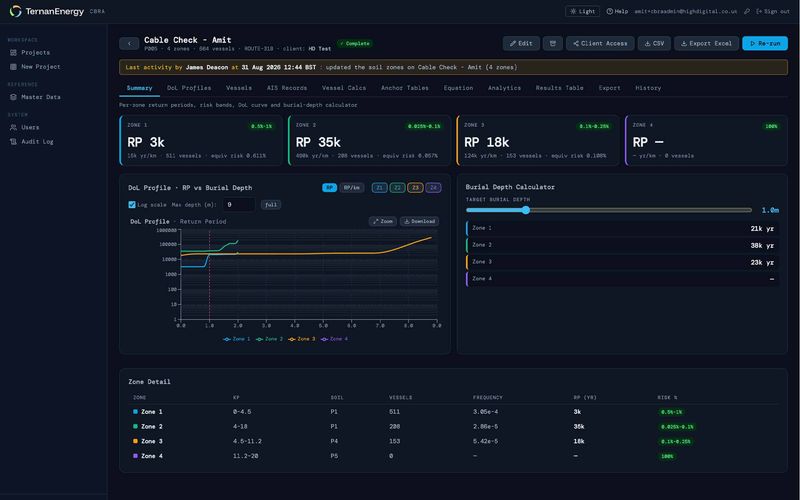
A 12-tab spreadsheet, rebuilt as a risk platform
Offshore cable burial risk assessment taken out of a straining Excel workbook and rebuilt as a Python engine and React application on Microsoft Azure — a hundred thousand rows of AIS vessel data, Carbon Trust anchor-strike methodology, and depth-of-lowering curves for every soil zone on a route.
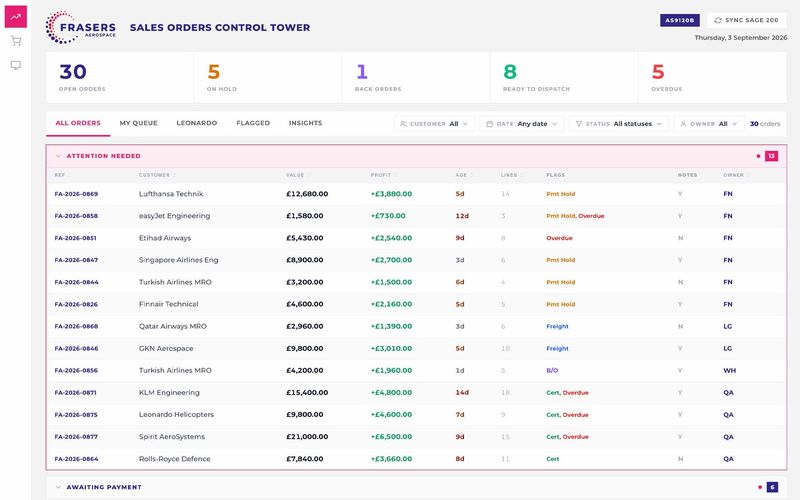
Frasers Aerospace — Operations Control Tower
An operations dashboard for an AS9120B aerospace supplier, built in Microsoft Lists and Power BI — orders from Sage 200 and WooCommerce in one place, the spreadsheets they used to be raised in retired, the exceptions blocking them surfaced first, and a TV wallboard for the warehouse floor.
“Most bad software isn’t badly built — it’s built to solve the wrong problem. Our job in discovery is to find that out in week one, not month six, before you’ve spent the budget.”

Sectors we've run discovery in.
Product discovery works in any domain — we've de-risked ideas for teams across all of these sectors.
Oliver's adept project management skills were evident as he consistently delivered all projects within set timelines.Read more client stories
More on product discovery.
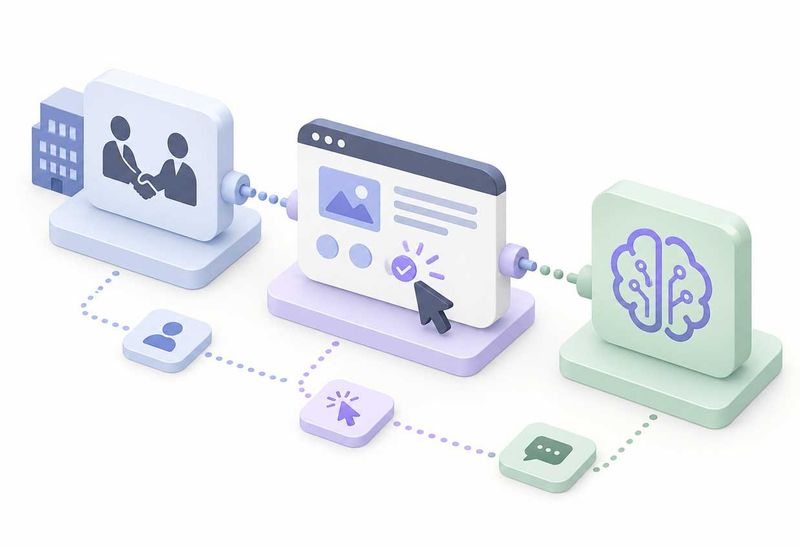
B2B White-papers Interactive Content & NLP
Week 5 of the High Digital AI Initiatives Series. Today, we are radically redesigning how B2B buyers interact with thought leadership content.
Read more
Fore-Site: Computer Vision for Field Operations
Week 4 of the High Digital AI Initiatives Series. This week, we’re moving from the database to the field, exploring applied computer vision
Read more
Hanse: Enterprise LLMs & Data Querying
Week 3 of the High Digital AI Initiatives. Today, we look at how Generative AI is replacing complex SQL queries in the trade data and supply chain analytics sector.
Read more





Digital product discovery,
and where it leads next.
Product discovery
We start by understanding your goals, your data landscape, and what success looks like. A structured process that validates your concept before a line of code is written.
Learn moreDigital product design (UI/UX)
From wireframes to polished interfaces, we design products that are as intuitive as they are functional.
Learn more 02Software prototype
A working prototype that proves your concept and gets real feedback fast.
Learn moreQuestions, answered straight.
Have an outcome in mind?
We'll help you
ship it.
- You're building a data product and need a team that can deliver.
- You want to get AI-ready — pragmatically, not theoretically.
- Your reporting is a mess and you need a real platform underneath it.